
The Wonderful Pilates Wunda Chair in Sugar Land: Why It Builds Strength, Awareness, and Pain-Free Movement
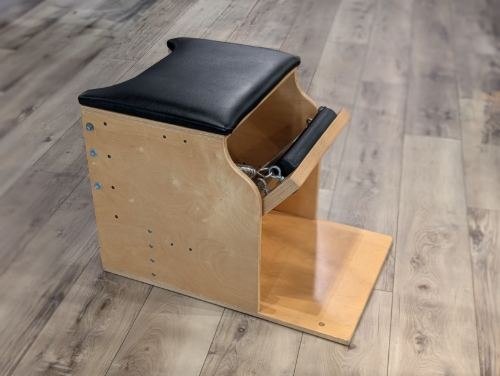
The Wunda Chair is a compact, versatile Pilates apparatus that delivers powerful results in strength, balance, and functional movement.
The Wunda Chair (or Pilates Chair) is one of the smallest pieces of equipment in the studio, and one of the most powerful. It’s a seat-like apparatus with a spring-loaded
Pedal. It strips away assistance requiring more body awareness and strength from you.
The “Chair” provides variable resistance for both pushing and pulling movements, allowing targeted work for the core, glutes, shoulders, hips, and stabilizers. Its portability and adaptability make it ideal for individualized sessions, Pilates classes, and rehabilitation-focused training.
Where the Wunda Chair Comes From
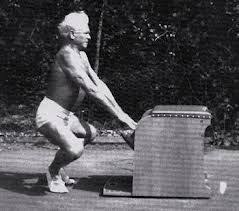
The Wunda Chair was originally created by Joseph Pilates as a compact, functional piece of equipment that could fit in a small space, sometimes even disguised as furniture.
It was designed to challenge the body in upright, gravity-loaded positions, where real life happens.
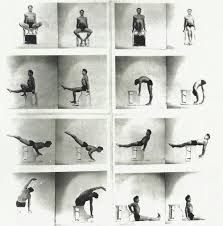
Unlike lying down on a Reformer, the Chair puts you in positions that demand:
- Balance
- Coordination
- Whole-body integration
- Control under load
It bridges the gap between exercise and real-world movement.
Awareness. Strength. And the ability to move without pain.
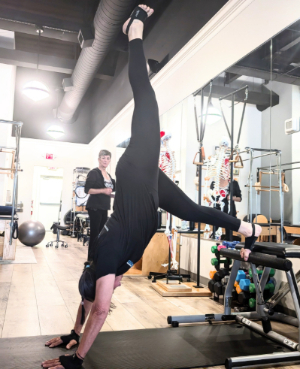
At Performance Pilates in Sugar Land, Texas, we use Wunda Chair workouts with a focus on fascial movement to enhance mobility, reduce pain, and improve athletic performance for clients of all ages.
Why does fascial movement matter?
Fascia is the connective tissue web that surrounds muscles, organs, nerves, and bones. Healthy fascial tissues transmit force efficiently, maintain hydration and glide between layers, and contribute to posture and movement economy. When fascia becomesrestricted (from injury, repetitive use, or inactivity), it can limit range of motion, alter movement patterns, and contribute to pain.
Focusing on fascial movement means:
● Encouraging multi-directional, integrated movement rather than isolated muscle work
● Restoring glide between tissue layers to improve joint mobility
● Enhancing proprioception and movement coordination
● Reducing compensatory patterns that lead to pain and injury
How does the Wunda Chair enhance fascial health?
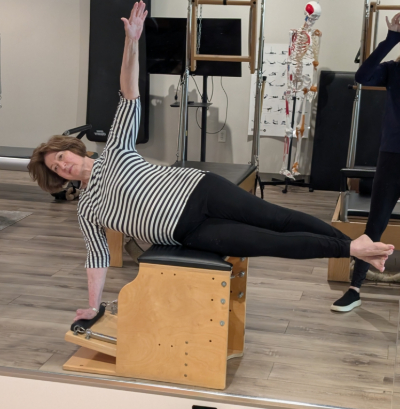
● Multi-planar loading: Exercises can combine flexion, extension, rotation, and lateral movement to stretch and load fascial lines.
● Variable resistance: Adjustable springs allow progressive loading that stimulates adaptation without overloading sensitive tissues.
● Small, controlled range options: Precise movements encourage quality of motion, improving fascial glide and neuromuscular control.
● Functional transitions: From standing to seated or single-leg work, the chair trains integrated patterns used in daily life and sport.
Key Wunda Chair exercises for fascial movement
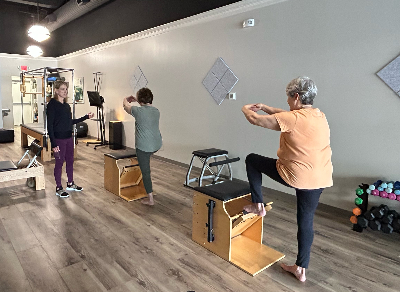
● Standing single-leg pedal press: trains hip stabilizers and lateral fascial lines.
● Seated spinal articulations with spring resistance: Promotes thoracolumbar fascia mobility and core control.
● Side plank variations using the chair pedal: loads shoulder and lateral trunk fascia in integrated patterns.
● Hand-to-pedal reaches: combines spinal rotation, shoulder mobility, and fascial continuity from hand to hip.
Why the Wunda Chair Is More Challenging
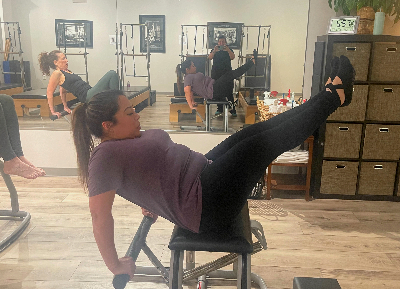
The Reformer and Cadillac provide guidance. The Chair removes it.
On the Reformer, the carriage supports your body and helps guide movement. On the Cadillac, springs can assist and stabilize.
On the Wunda Chair:
- Your base of support is smaller
- Your center of mass is higher
- There is less feedback from the equipment
- Your body has to organize itself
That means no hiding. If one area is overworking or another is underperforming, the Chair exposes it immediately, and the body has to adapt. That’s the challenge. Not because it’s harder for the sake of being hard, but because it’s more honest.
As we get older, we need this challenge in the Pilates Studio setting to stay active and functional in daily life. The Wunda Chair forces your body to answer a different question:
Can you organize movement efficiently from the ground up?
From Tension to Transmission: The Fascial Difference…Pain Free Movement.
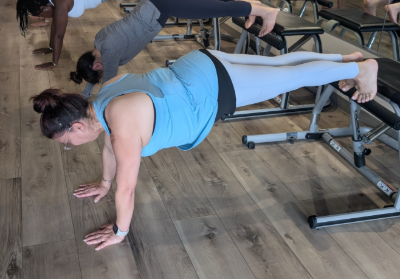
We focus on myofascia, the connective tissue system that links your entire body together. When there is excess tension in the system, force gets stuck. That’s when you start to see:
- Compensations
- Overuse in certain areas
- Underuse in others
- Pain that seems to “move around”
On the Wunda Chair, when we help you release unnecessary tension, force begins to transmit through the whole body instead of getting blocked.
This is what allows movement to feel:
- Lighter
- More coordinated
- More powerful without strain
Instead of isolating muscles, we restore continuity through the fascial lines, so your body works as one integrated system.
Pilates For Pain Free Movement After 40
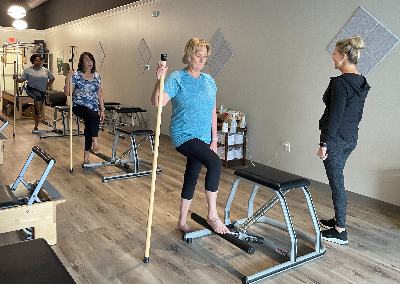
As we get older, the goal is not just strength. It’s usable strength.
Strength that transfers to:
- Walking
- Climbing stairs
- Playing golf or tennis
- Getting up and down from the floor
- Living independently and confidently
The Wunda Chair trains your body in a way that directly supports these real-life demands.
Combined with fascial movement principles, it helps you:
- Move with less pain
- Improve balance and coordination
- Maintain strength without excessive strain
- Stay active doing the things you enjoy
A Smarter Way to Start: Pilates Assessment Sugar Land
If you’ve never used a Wunda Chair before, the goal is not to “get through a workout.” It’s to understand how your body moves, and how to make it work better.
…That’s exactly what we do in our Move Smarter Intro.
It’s a one-on-one assessment and movement consultation where we:
- Look at how your body organizes movement
- Identify where tension is limiting you
- Introduce you to fascial-based Pilates concepts
- Map out the best next step for you
If your goal is to stay active, move well, and feel better in your body, not just today, but long-term, this is the place to start.