
Why Stretching Is Overrated and Why Fascia-Focused Movement Is the Future of Flexibility

For decades, we’ve been told that flexibility comes from stretching. The deeper you go, the better. But here’s the truth: stretching is one of the most overrated concepts in fitness.
Static stretches and forced positions might make you feel looser temporarily, but they don’t create the kind of supple, resilient body that moves with ease and power.
That’s because your body doesn’t move in straight lines and neither does your fascia.
The Problem With Traditional Stretching
When we stretch in the old-school way, holding a position and waiting for the muscle to “let go”, we’re only talking to one small part of a much bigger system.
So when you tug on one piece (say, your hamstring), you’re really tugging on an entire network that extends from your heel to your head.
This is why traditional stretching often feels like chasing tightness: you pull one spot, and another lights up. You’re not addressing the system, you’re just chasing symptoms.
“At Performance Pilates in Sugar Land, TX, we take a different approach to flexibility…“
Muscles don’t work in isolation. They’re woven together by fascia , the continuous, 3D web that wraps every cell, muscle, organ, and bone in your body.
Fascia: The Missing Link in True Flexibility
Thomas Myers’ groundbreaking work in Anatomy Trains reframed the way we see the body.
He showed that we’re built in myofascial meridians. Long, continuous chains of connective tissue that transmit force, tension, and energy throughout the body.
Your Superficial Back Line, for example, connects the soles of your feet all the way up the back body to your scalp.
When fascia glides, slides, and responds elastically, movement feels effortless. When it’s dry, stuck, or untrained, we feel stiff, heavy, and limited. No matter how much we stretch.
Why Working “In All Directions” Changes Everything
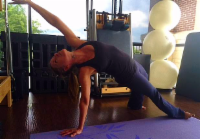
Fascia loves variety.
It’s designed to spiral, bounce, and recoil. It thrives on dynamic, multi-directional movement . Not repetitive, one-dimensional stretches.
When we move in all directions, fascia becomes hydrated, elastic, and alive.
That’s why practices rooted in fascial movement like spiral Pilates sequences, rebounding, or elastic resistance work create a kind of spring-loaded flexibility that lasts.
As Thomas Myers says, fascia needs “load and glide” gentle tension followed by release, repeated through motion.
It’s about creating fluid adaptability, not forcing a shape.
Practical Ways to Train Your Fascia
You don’t need fancy tools to move fascially, you just need awareness.
Here are simple ways to start:
- Think in spirals, not lines. Add rotation and oppositional reach to your Pilates practice.
- Stay dynamic. Replace long static stretches with flowing, bouncing, or oscillating movements.
- Hydrate your tissue. Movement is the pump that brings fluid through fascia. Gentle rolling, gliding, and variety keep it supple.
- Feel for elasticity, not stretch. Move to the edge of your range, then rebound out, like a cat, not a rubber band.
From Stretching to Sensing
The future of flexibility isn’t about how far you can pull. It’s about how deeply you can feel and respond.
When your fascia is awake and hydrated, your body becomes a responsive, intelligent system. Not a collection of tight spots.
So the next time you think you need to “stretch more,” try this instead:
Move in all directions. Glide. Spiral. Bounce.
You’ll find a deeper, more lasting freedom. One that doesn’t just lengthen you, but connects you.
💥 Ready to stop “stretching” and start moving smarter?
Learn More, and book your first fascia-focused Pilates Consultation at Performance Pilates Sugar Land today!
Performance Pilates, 2158 Texas Drive, Sugar Land Town Square. 281-937-7761