
Arm Lines in Pilates: What They Are & Why They Matter.
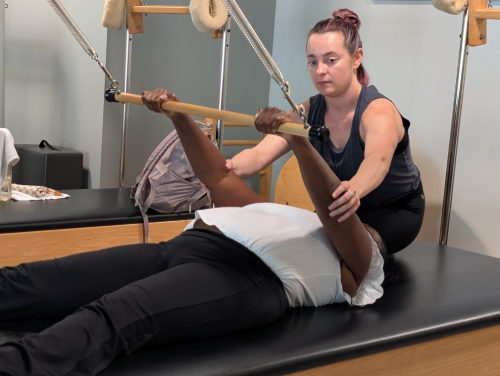
If you’ve ever experienced wrist pain or shoulder tension during planks, neck tightness during arm work, or difficulty maintaining posture throughout the day, your arm lines are likely part of the story.
At Performance Pilates, in Sugar Land, Texas, we focus on whole body movement not isolation. When we help you connect, and understand your arm lines in Pilates, you’ll discover distribution from you hands through your arms, all the way down through your trunk to the pelvis. Our arm lines are involved in everything we do. They give us strength, stability, and balance. Distribution through arm lines reduces isolated pain in the wrists and shoulders, and supports posture. That’s why strengthening the upper body requires more than just working your biceps and triceps.
What Are Arm Lines?
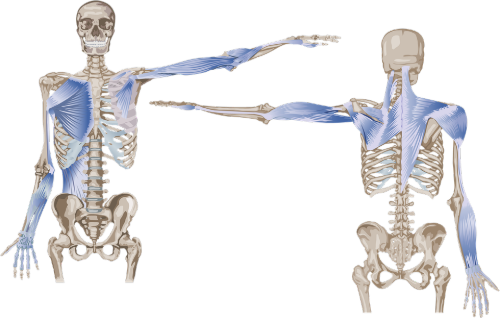
The “arm lines” are 4 of several myofascia lines that we reference from Thomas Myers book, the Anatomy Trains. The myofascial lines are continuous pathways of connective tissue that connect and organize movement throughout the body.
Instead of viewing the arm as separate parts (forearm, biceps, shoulder), the arm lines connect:
- Fingers
- Palms
- Forearms
- Elbows
- Upper arms
- Shoulder complex
- Chest
- Upper back
In short, arm lines organize how force travels through the upper body down to the pelvis.
Four Primary Arm Lines:
1. Superficial Front Arm Line (SFAL)
Palm to pec major, to lats, to pelvis.
Flexion of the palm supports gripping and pulling. Your palm contacting a surface activates pec major and latisumus dorsi when holding a plank. Hanging from your hands & arms stretches to the pelvis. It is also present in flexion movements. SFAL is often shortened from typing and phone use.
2. Superficial Back Arm Line (SBAL)
The back of your hand, up the forearm to the humerus, deltoid and trapezius.
It goes from the base of the skull, down the back of the neck, widenting to the shoulders, then taking on the shape of a kite as it goes all the way down to T-12 (… your bottom rib level of the spine). SBAL controls the arm when you reach back behind you (…a backhand in tennis). It counters forward flexion from SFAL, and lifts the shoulder and arm.
SBAL is the line responsible for elevating your shoulders to your ears. It gets tight when using a mouse on your computer and can send tension and pain up to your shoulder and neck. If SBAL is tight, it can contribute to forward head posture.
3. Deep Front Arm Line (DFAL)
DFAL travels from the thumb to the bicep to the pec minor.
Supports shoulder stability and fine motor control. Can contribute to tight chest, rounded shoulders, and forward head posture.
4. Deep Back Arm Line (DBAL)
DBAL goes from you pinky finger, to the elbow, tricep, the rotator cuff muscles, scapula, and rhomboids. It starts at one pinky finger and goes around to the other pinky finger, making a “hammock” that assists in rolling up and rolling down. This line also travels up the transverse processes of the cervical spine (…the pointy bones on the side of the spine in the neck).
Supports scapular organization and postural alignment. All of the arm lines work together, balancing each other.
Why Arm Lines Matter for Shoulder Health:
Shoulder Pain:
Many people search for “Pilates for shoulder pain”, but shoulder discomfort is rarely just a shoulder issue.
When arm lines lose balance, we often see:
- Neck tension
- Forward head posture
- Rounded shoulders
- Weak scapular stability
- Elbow or wrist irritation
How Arm Lines Affect Posture:
Modern life shortens the superficial front arm line and tightens Deep Front Arm Line.
- Computer work
- Driving
- Phone scrolling
- Stress
This pulls the shoulders and head forward and narrows the chest.
At the same time, the superficial back arm line gets pulled up and tight.
Pilates helps by creating balance between the two.
Better posture is not about forcing yourself upright. It’s about restoring balanced tension in the fascial system.
Arm Lines in Pilates
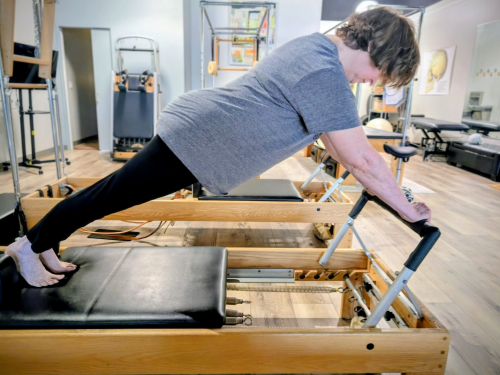
When the arm lines are accessible, connected and balanced, we find them in every exercise we do. With arm line stability, we can let go of tension and experience load distribution and muscle activation through the whole body. Your plank is held up via distribution from the palm, lat, to pelvis. The pinky and the tricep, and your thumb, bicep and pec minor. Then you have activation of the hamstrings in the Superfiscial Back Line (SBL) holding you up, making you as stable as a park bench.
Benefits of Training Arm Lines in Pilates
✔ Less shoulder pain
✔ Reduced neck tension
✔ Improved posture
✔ Stronger planks
✔ More stable push-ups
✔ Better overhead control
✔ Increased upper body strength
This is why Pilates is highly effective for shoulder health and posture correction.
Ready to Improve Your Shoulder Strength & Posture?
If you’re experiencing shoulder tension, rounded posture, or upper body weakness, Pilates can help retrain your arm lines and restore balance.
Book your Move Smarter Intro session today and experience connected, pain-free movement.